
California Medical AI Law Guide (2026)
Navigating the complex landscape of California's healthcare artificial intelligence regulations. A deep dive into AB 489, AB 3030, and the future of digital health compliance.
The 2026 Regulatory Landscape
As of January 1, 2026, California has solidified its position as the strictest regulator of artificial intelligence in healthcare. The "Wild West" era of digital health is over. Two landmark bills, Assembly Bill 489 and Assembly Bill 3030, have fundamentally changed how providers, developers, and health systems must deploy AI tools.
For medical clinics and tech startups alike, the message is clear: Transparency is no longer optional; it is a legal mandate. This guide breaks down exactly what you need to know to keep your license safe and your technology compliant.
The 2026 Enforcement Clock
AG's office begins automated scrapers to identify non-compliant patient portals.
First wave of penalties for "Clinical Camouflage" violations (AB 489).
Mandatory algorithmic bias testing and training data disclosure requirements.
Deep Dive: AB 489 (The Transparency Mandate)
AB 489 was born out of patient confusion. In early pilot programs, patients often couldn't distinguish between a chat with a nurse and a chat with an advanced LLM. AB 489 solves this by enforcing the "Right to Know."
Core Requirements:
- Immediate Disclosure: The very first interaction—whether a text bubble, a voice greeting, or a video avatar—must explicitly state that the entity is an Artificial Intelligence.
- Prohibition of Clinical Camouflage: It is strictly unlawful for an AI agent to use titles reserved for licensed professionals. An AI cannot call itself "Dr. Bot," "Nurse Sarah," or use the post-nominal letters "M.D." or "R.N."
- Visual Cues: If the AI uses a visual avatar, it cannot wear a white coat, stethoscope, or scrubs unless there is a prominent, permanent label reading "AI VIRTUAL ASSISTANT" covering at least 20% of the image.
Deep Dive: AB 3030 (Generative AI & Clinical Responsibility)
While AB 489 handles identity, AB 3030 handles content. This bill targets Generative AI (GenAI) specifically. The legislature recognized that GenAI can hallucinate, and in medicine, a hallucination can be fatal.
The "Human-in-the-Loop" Exemption
Crucially, AB 3030 offers a safe harbor. If a licensed healthcare professional reviews and approves the AI's output before it is sent to the patient, the strict disclaimer requirements are relaxed. However, this review must be substantive, not just a rubber stamp.
The $250k Hallucination: Civil Liability
Under the updated Confidentiality of Medical Information Act (CMIA), if an unreviewed AI hallucination leads to unauthorized data disclosure or incorrect medical instructions, the potential for statutory damages is immense.
- $2,500: Minimum fine per negligent disclosure.
- $250,000: Maximum fine for "knowing and willful" non-compliance.
- Licensure Risk: The Medical Board can view repeated AI errors as "gross negligence," leading to loss of M.D. or R.N. status.
At-a-Glance: Comparing the Big Three Laws
| Law | Primary Focus | Deadline |
|---|---|---|
| AB 489 | Transparency (Identity) | Jan 1, 2026 |
| AB 3030 | Generative AI Output | Jan 1, 2025 (Retroactive) |
| SB 942 | Content Provenance (Digital Evidence) | July 1, 2026 |
2026 Compliance Strategy: The "Sandwich" Method
To ensure robust compliance without ruining the user experience, we recommend the "Sandwich" disclosure method for all chat-based interfaces:
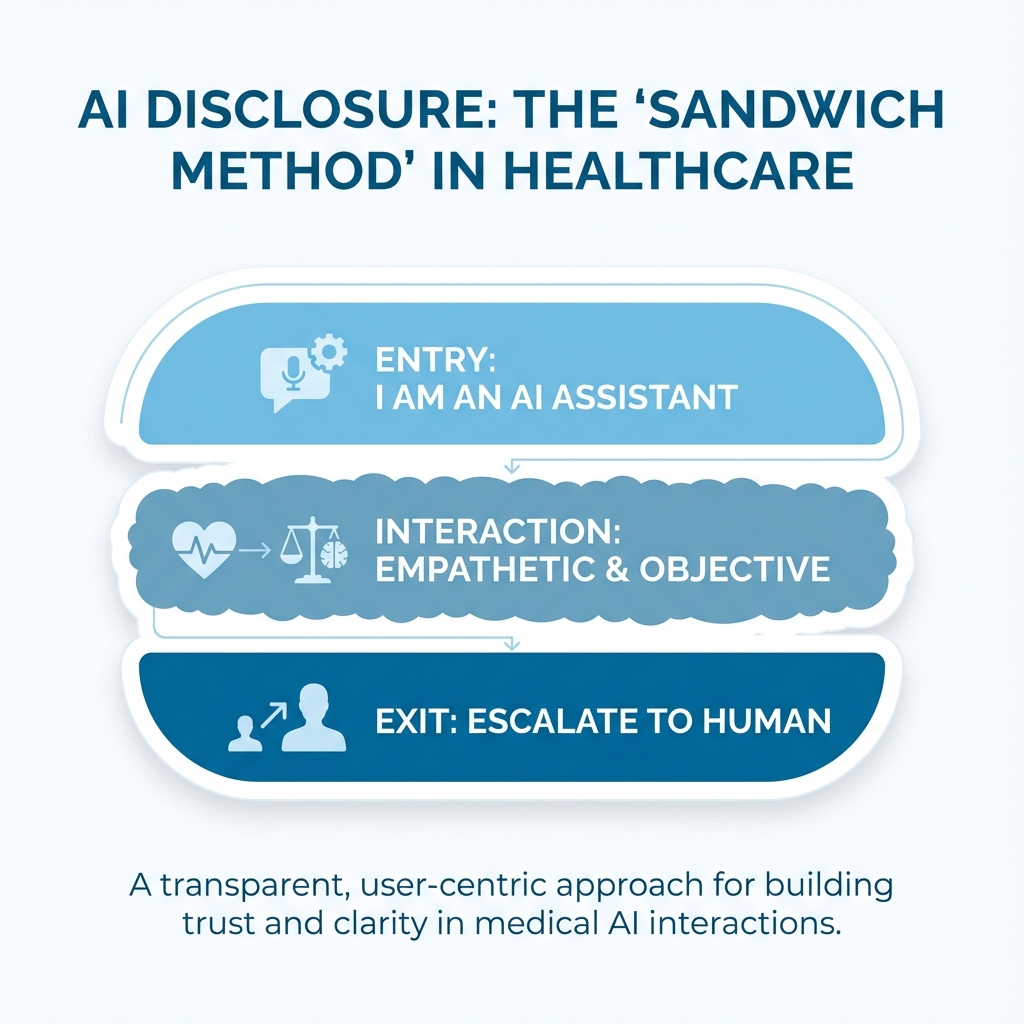
- The Top Bun (Entry): Start every session with a hard-coded system message: "I am an AI assistant. I cannot provide medical diagnosis."
- The Meat (Interaction): Allow the conversation to flow naturally. Ensure your AI's tone is empathetic but objective.
- The Bottom Bun (Exit/Handoff): Always provide a persistent "Escalate to Human" button. If the AI detects high-risk keywords (e.g., "pain", "emergency", "suicide"), it must immediately break character and route to a human.
Implementation Guide for Clinics
If you are a medical practice deploying these tools, do not rely solely on the software vendor's word. You are ultimately liable for the care provided under your license. We have developed local guides for major California hubs:
- Is your medical chatbot legal under California AB 3030? — full checklist with the human-review exemption explained
- Los Angeles Medical Device AI Compliance Guide
- Sausalito Legal Compliance Monitoring
1. Update Your Notice of Privacy Practices (NPP)
Your HIPAA NPP should be updated to explicitly mention the use of AI tools for patient communication and data analysis.
2. The "White Coat" Audit
Review all marketing materials and user interfaces. Does your chatbot have a name like "Dr. AI"? Rename it immediately. Does its avatar wear scrubs? Change it to a branded t-shirt or an abstract logo. These visual changes are low-effort but high-impact for compliance.
3. Log Everything
In the event of a malpractice suit involving AI, your best defense is a complete, immutable log of the interaction. You need to prove exactly what the AI said and, more importantly, what it didn't say. Ensure your vendor retains these logs for a minimum of 7 years (matching medical record retention standards).
Technical Specification: Developer Check
For CTOs and Lead Developers, compliance requires changes at the System Prompt and UI Layer.
// AB 3030 System Prompt Injection Pattern
const system_instructions = ` (1) You are an AI, not a doctor. (2) Do not provide diagnosis. (3) If asked for medical advice, provide standard disclaimers per CA AB-3030. (4) Route emergency keywords to 911.`;
Future-Proofing: SB 942 & The Provenance Shift
While you focus on 2026, the 2027 mandates are already looming. Senate Bill 942 will eventually require "latent watermarking" on all medical images generated or enhanced by AI. This means the metadata of your files will need to carry an immutable certificate of origin.
Official Resources & Further Reading
Don't just take our word for it. Verify these requirements directly with the source.